Kenya is short nearly 100,000 teachers, and the number is growing. The government is hiring, but is it enough? Could artificial intelligence help bridge the gap, or is that just another promise that sounds better on paper than in a classroom?
Emmanuel Karanja
·
10 Apr 2026
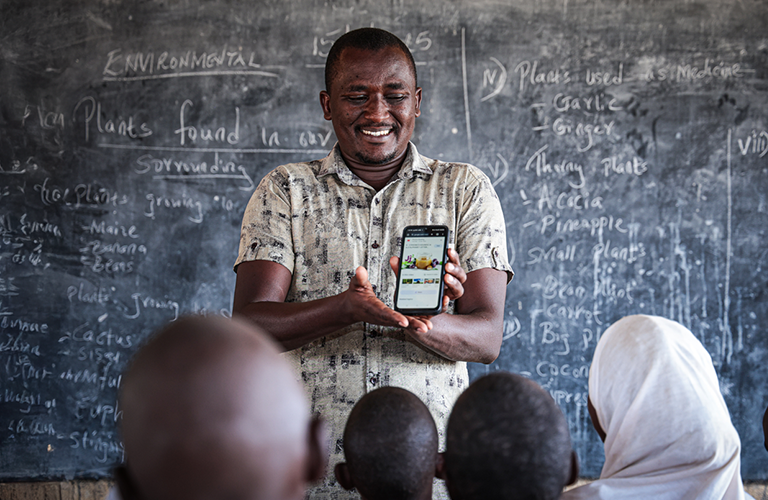
A teacher conducts a lesson in a Kenyan primary school classroom.
In April 2025, the TSC told Parliament something that surprised no one in the education sector but alarmed everyone hearing the number out loud: Kenya has a shortage of 98,261 teachers.
That figure is expected to grow. In January 2026, over one million learners transitioned to Grade 10 under the new CBE system, entering senior school for the first time. The TSC projected that this transition alone requires an additional 58,590 teachers, with the STEM pathway facing the most acute shortfall. Subjects like marine and fisheries, aviation, computer studies, music, fine arts, and Sign language have so few qualified teachers that some schools simply cannot offer them.
The government is not standing still. A recruitment drive aims to bring 116,000 new teachers into the system over five years, with 24,000 hired in 2025 and another 16,000 planned for 2026. But budget constraints keep slowing things down. Thousands of intern teachers remain on short-term contracts. The number of teachers in public primary schools actually fell by 3.2% in 2024, even as student enrolment climbed.
Hiring alone will not close this gap fast enough. Which raises a question that is increasingly hard to avoid: can technology, and specifically AI, help?
Before jumping to that answer, it is worth looking at what Kenya has already tried. Because this is not the first time the country has bet on technology to fix a problem in education. And the results have been mixed.
The KES 32 Billion Lesson
Tablets from the Digital Literacy Programme in a Kenyan primary school. Over 1.2 million devices were distributed, but many ended up unused.
In 2013, the Jubilee administration of Uhuru Kenyatta and William Ruto ran one of the most memorable campaign promises in Kenyan political history. Every child enrolling in Standard One would receive a laptop. The ticket branded itself “digital” while calling their opponents “analogue.” It was bold, quotable, and it stuck.
The reality that followed was more complicated. The laptop promise evolved into the DLP, an effort to integrate ICT into primary school learning. Laptops became tablets. The programme distributed over 1.2 million devices to more than 19,000 public primary schools across the country, trained over 229,000 teachers, and cost an estimated KES 32 billion.
On paper, the DLP was one of the most ambitious education technology rollouts in Africa. On the ground, the picture was different.
“
The gadgets procured now largely lie idle, and are underutilised or broken, while some have been stolen.
— Daily Nation investigation, 2022
A University of Notre Dame study found that in rural schools, power blackouts were frequent and internet signals were almost non-existent. Some classrooms did not even have electrical sockets. The devices ended up locked in staff rooms, brought out only when Ministry of Education officials came for inspections. Many teachers reported that the training they received was too short and did not prepare them to actually use the tablets in a classroom setting.
By 2019, the government had quietly acknowledged that the original project was not viable. A KHRC report noted that criticism focused on whether laptops should be a priority in schools that lacked electricity, clean water, and enough desks.
But it was not all failure. Where the infrastructure held up, the impact was real. Teachers reported that students became more engaged and that absenteeism dropped. The programme generated around 11,000 jobs in device assembly, content development, and ICT support. And it put digital learning on the national agenda in a way that had not happened before.
The lesson was not that technology in schools is a bad idea. The lesson was that hardware without infrastructure, teacher training, and a clear content strategy does not work. You cannot solve education problems by dropping devices into schools and hoping for the best.
Digital Literacy Programme by the Numbers
1.2M
Devices distributed
19,000+
Schools covered
229,000
Teachers trained
KES 32B
Total cost
Source: Ministry of Education
What Actually Worked: The Rise of Kenyan EdTech
While the DLP struggled with logistics, a different kind of digital education was quietly succeeding. It did not come from the government. It came from Kenyan startups that understood something the DLP had missed: teachers already had devices in their pockets. They just needed software that solved a real problem.
The clearest example is Zeraki.
Founded in 2014, Zeraki started with a simple observation. In most Kenyan secondary schools, there were only two or three computers in the dean’s office. At the end of every term, all 30 teachers would line up behind those computers to enter exam results. The process took days. Report cards came out late. Data was riddled with errors.
Zeraki moved the entire workflow to mobile phones. Teachers could enter grades from home the moment they finished marking. The system calculated averages, generated report cards, and made performance data available to parents and school administrators instantly.
By 2023, Zeraki Analytics was being used in over 5,800 secondary schools, more than half of all high schools in Kenya. And this was not just an urban phenomenon. According to the Mastercard Foundation, 63% of the schools using Zeraki were rural, with fewer than 500 students each. Schools reported that administrative time dropped by up to 70%.
“
Schools using Zeraki report reduced time spent on administrative tasks by up to 70%, increased parental engagement in children's education, and improved learning outcomes.
— Mastercard Foundation, 2023
Zeraki was not the only success story. Eneza Education built a learning platform that worked on basic phones via USSD, the same technology behind M-Pesa, reaching students who had no access to smartphones or internet. Kytabu pioneered a model where students could rent digital textbooks by the page or chapter, making learning materials affordable for families who could not buy full books.
The pattern was consistent. The EdTech solutions that worked in Kenya shared three traits: they were mobile-first, they solved a specific pain point that teachers or administrators actually had, and they required zero new hardware. They worked with what people already owned.
This is the foundation that any AI-in-education conversation in Kenya needs to build on. Not the DLP’s top-down, hardware-first approach, but the ground-up, mobile-first approach that Zeraki and others proved could scale.
So Where Does AI Come In?
The conditions for introducing AI into Kenyan education are better today than they have ever been.
Smartphone penetration hit 92.9% of all mobile devices by December 2025, according to the CA. The country had over 48.7 million smartphones in active use. 4G mobile broadband subscriptions reached 44.2 million, with 5G adding another 1.7 million. KEMIS went live in January 2026, giving schools a reason to digitise records. And the EU-funded LCMS project is connecting hundreds of public primary schools to internet for the first time.
The infrastructure problems that crippled the DLP have not fully disappeared, but they have dramatically shrunk. The question is no longer whether technology can reach Kenyan schools. It is what kind of technology can make the biggest difference.
Here is the case for AI, broken into the areas where it could have the most practical impact.
Filling the Specialisation Gap
This is the most compelling argument for AI in Kenyan education, because it addresses a problem that hiring alone cannot solve.
The TSC has identified severe teacher shortages in subjects like marine and fisheries, aviation technology, computer studies, music, fine arts, and foreign languages including French, German, Mandarin, and Sign language. For some of these subjects, there are almost no trained teachers in the entire country. TSC Director of Quality Assurance Reuben Nthamburi told a conference in late 2025 that he did not know of a single university producing marine and fisheries teachers.
Projected Teacher Demand for Grade 10 (2026) — by Pathway
STEM35,111
Social Sciences14,630
Arts & Sports8,778
Source: TSC
AI cannot replace a marine science teacher. But it can provide structured, curriculum-aligned content in subjects where no teacher exists at all. An AI tutor that walks a student through marine biology concepts, provides practice questions, and gives feedback on answers is not ideal. But it is better than the current alternative, which in many schools is nothing.
This is where AI’s role is clearest: not replacing good teachers, but showing up where no teacher is available.
Reducing Teacher Workload
A Kenyan teacher’s day extends far beyond the classroom. There is attendance marking, grade entry, report card writing, lesson plan preparation, parent communication, and in many schools, administrative tasks that have nothing to do with teaching.
AI-powered tools can take significant chunks of this workload off teachers’ plates. Automated lesson plan drafting based on the KICD syllabus. AI-generated assessment feedback that teachers can review and personalise rather than write from scratch. Performance summaries that flag at-risk students before the end of term, rather than after.
This is not speculative. These are capabilities that exist in AI systems today. The question for Kenya is not whether the technology works, but whether it can be delivered in a format that Kenyan teachers will actually use. And the Zeraki example shows that the answer is yes, as long as it runs on a phone, solves a real problem, and does not require a training course to understand.
Personalised Learning at Scale
In a classroom of 60 students with one teacher, individual attention is a fantasy. Every teacher knows that some students are ahead and bored while others are behind and lost. There is no time to address both groups properly.
AI can provide what one teacher in a crowded classroom cannot: a learning experience that adapts to each student. If a student is struggling with fractions, the system can provide additional practice at the right difficulty level. If another student has already mastered the topic, the system can move them forward. This is the kind of personalisation that Zeraki Learning was already doing in a basic form. AI takes it further by adapting in real time based on how the student responds.
“
In a classroom of 60, a teacher cannot give each student individual attention. But a well-designed AI tutor can adapt to each learner's pace and fill the gaps that a stretched teacher simply does not have time to address.
Data-Driven Decisions for School Leaders
Most principals in Kenya make end-of-term decisions based on incomplete information, because gathering and analysing school data manually is slow and error-prone. Which subjects are consistently underperforming? Is there a correlation between attendance patterns and grade drops? Which fee items have the highest default rates?
AI can surface these insights continuously, not just at the end of term. A principal who knows in Week 4 that Grade 7 maths scores are trending 15% below last term’s average can intervene. A principal who only finds out in Week 13 cannot.
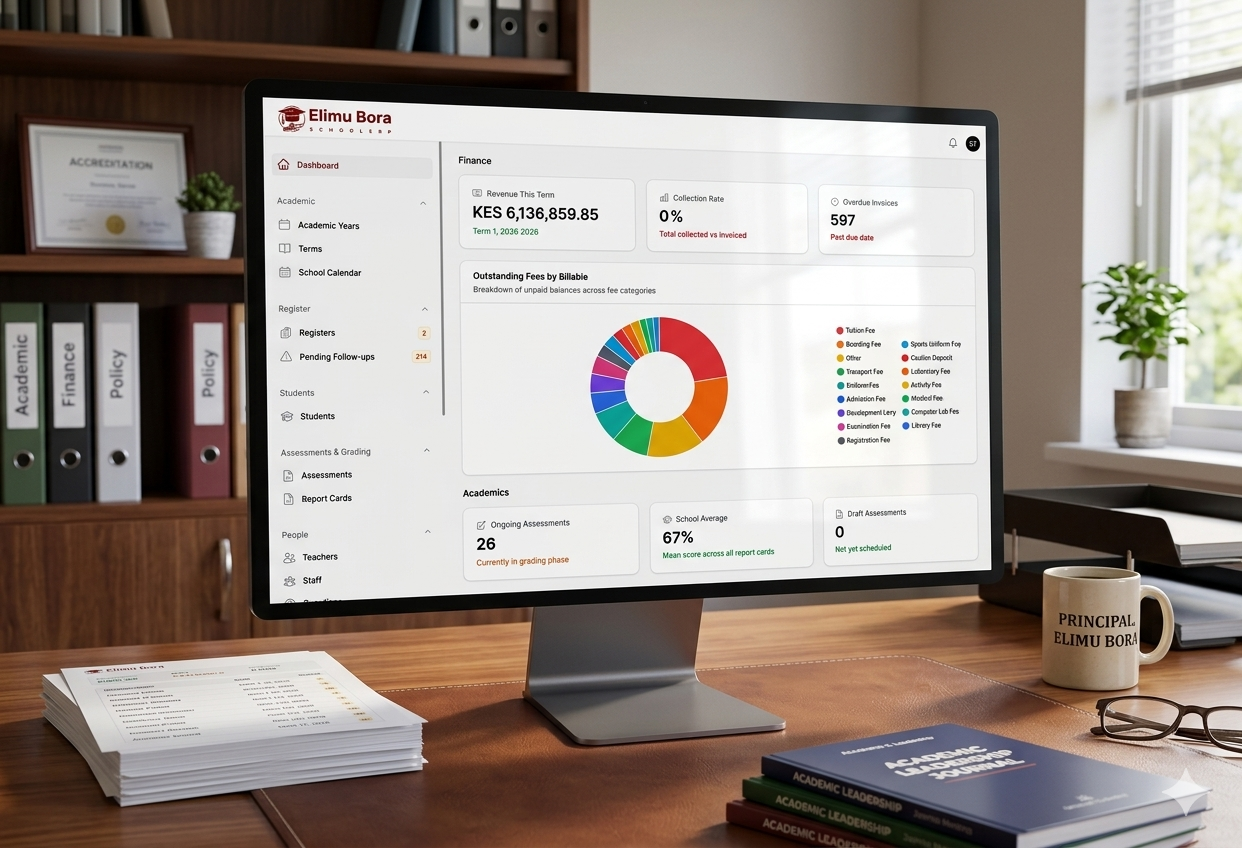
This is the direction that school management platforms are moving. Elimu Bora School Management System, for example, is building AI-powered insights that analyse attendance, academic performance, and financial data to give school leaders actionable information throughout the term, rather than just a static report at the end of it.
What AI Cannot Do
It would be irresponsible to write about AI in education without being honest about what it cannot fix. And in the Kenyan context, the limitations are significant.
It Cannot Replace Human Connection
A Grade 1 learner who is scared on their first day of school needs a teacher who can kneel down, make eye contact, and tell them everything will be fine. A teenager navigating adolescence needs a mentor, not a chatbot. A student with a learning disability needs a teacher who can observe their behaviour, adapt in the moment, and communicate with their parents about what is working and what is not.
Teaching is a deeply human profession. AI can assist with content delivery and administrative tasks, but the pastoral, emotional, and disciplinary dimensions of a teacher’s role cannot be automated.
It Still Needs Infrastructure
If the DLP tablets ended up locked in cupboards because schools had no electricity or internet, AI tools face the same risk. Only an estimated 30% of Kenya’s 23,400 public primary schools were online by early 2026, according to UNICEF. The LCMS project is expanding connectivity, but the gap remains enormous, especially in ASAL counties.
AI that runs on a smartphone with a mobile data connection can reach further than AI that requires a laptop and broadband. But it still cannot reach a school with no signal.
The Digital Literacy Gap Among Teachers
The DLP trained 229,000 teachers and many still could not use the tablets effectively. Rolling out AI tools into schools faces the same adoption challenge. If a teacher does not understand what the tool does, does not trust it, or sees it as extra work rather than a time-saver, it will not be used.
Any AI deployment in Kenyan schools needs to be accompanied by training that is practical, ongoing, and delivered in a format teachers can access, ideally on their phones, in short modules, during times that fit their schedules.
Mobile-first tools have proven the most effective at reaching Kenyan teachers, both in urban and rural schools.
Data Privacy for Children
AI systems that personalise learning need student data to function. Under the DPA (2019), data relating to children under 18 requires parental consent and can only be used for the stated educational purpose. There is no room for profiling, secondary use, or data sharing with third parties.
Any AI tool deployed in Kenyan schools must be built with these constraints from day one, not retrofitted after launch. The ODPC is increasingly active, and schools that adopt AI tools without understanding their data obligations are exposing themselves and the families they serve.
The Honest Answer
Can AI solve Kenya’s teacher shortage? No. Not on its own.
The country needs more teachers. It needs them hired, trained, deployed, and paid properly. No amount of technology changes that. The 98,261 teacher deficit will not be closed by software.
But AI can make each existing teacher more effective. It can take administrative work off their plate so they spend more time teaching. It can provide content in subjects where no qualified teacher exists. It can give principals the data they need to make better decisions earlier in the term. And it can offer personalised learning support to students in classrooms that are too crowded for one teacher to reach every child.
The DLP showed that technology without strategy fails. Zeraki showed that the right tool, delivered the right way, can reach more than half the schools in the country. The next chapter is about building on what Zeraki proved, using AI to go further, while learning from the mistakes the DLP already made.
The infrastructure is better than it has ever been. The smartphone is in nearly every pocket. The curriculum transition is creating demand for smarter tools. And the teacher shortage is not going away any time soon.
AI is not the answer. But it is part of one.
Did You Know?
According to Education Cabinet Secretary Julius Ogamba, there are 343,485 registered and qualified teachers in Kenya who are not employed by the TSC. This includes 84,510 post-primary teachers, 124,061 primary school teachers, and 134,914 ECDE teachers. The teacher shortage is as much a funding problem as it is a supply problem.