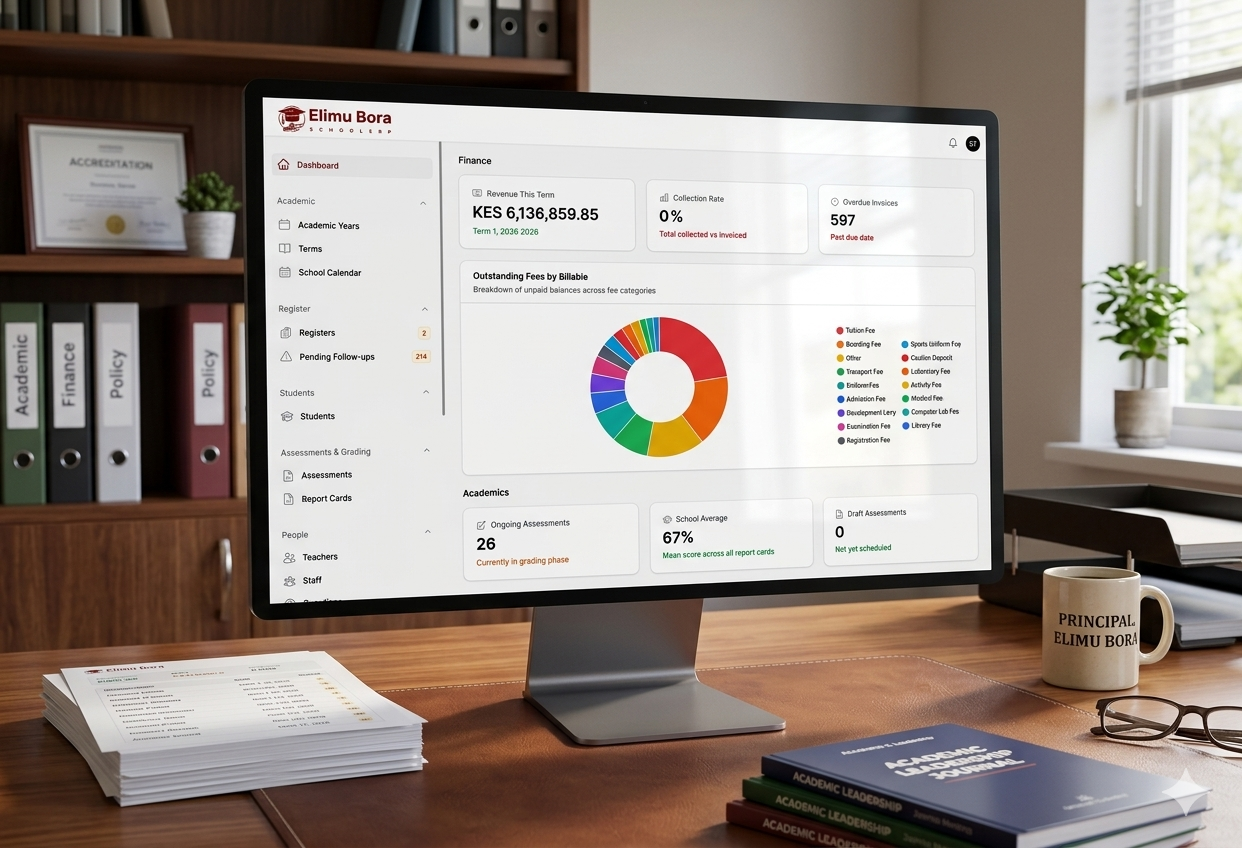
Running a school in Kenya means juggling paper registers, M-Pesa messages, and endless WhatsApp follow-ups. Elimu Bora brings all of that into one place, built from the ground up for how Kenyan schools actually work.
Emmanuel Karanja
·
02 Apr 2026
Photo by Katerina Holmes from Pexels
If you have ever managed a Kenyan school, you know the routine. Fee payments come in through M-Pesa, but tracking them means scrolling through transaction messages and matching them to students by hand. Attendance is recorded in a register that sits in a drawer until someone needs it weeks later. Report cards are typed up in Word documents, printed, and handed out at the gate. And when a parent calls to ask about their child’s balance or grades, someone has to dig through folders to find the answer.
It works, until it does not. One missed payment. One lost register. One report card with the wrong grade. These small cracks add up, and the people who feel them most are the principals, teachers, and parents who just want things to run smoothly.
That is why we built Elimu Bora.
What Elimu Bora Actually Does
Elimu Bora is a school management platform that handles the daily operations most Kenyan schools still do on paper. Academics, attendance, fee collection, inventory, events, and parent communication all live in one system that every stakeholder can access based on their role.
The name comes from Swahili: Elimu Bora means “quality education.” We picked it because the platform is not just about digitising paperwork. It is about giving schools the tools to focus on what actually matters: teaching and learning.
Here is what that looks like in practice:
For principals and administrators, Elimu Bora provides a clear picture of the school at any given moment. Fee collection status, attendance trends, assessment results, and inventory levels are all visible from a single dashboard. No more chasing down the bursar for a fees update or waiting for end-of-term reports to know how students are performing.
For teachers, grade entry happens directly in the system. Once an assessment is created and the grading window opens, teachers enter scores that are automatically converted into percentages and grade bands based on a customizable grading scale. Report cards are generated from that data, ranked, and published to parents without the usual end-of-term scramble.
For parents and guardians, a dedicated portal shows their child’s grades, attendance record, fee balance, and upcoming school events. When a child is marked absent or late, the parent gets a notification. When a payment is received, they get a confirmation. No more “I sent the fees last week” conversations with no paper trail.
Built for How Kenyan Schools Actually Operate
There are school management systems out there. Some of them are quite good. But most of them were built for school systems in the US, UK, or India, and then adapted for the Kenyan market as an afterthought. That adaptation usually means bolting on M-Pesa as a payment option and calling it a day.
Elimu Bora takes a different approach. Every decision we have made, from the database structure to the grading logic, starts with the Kenyan school system.
Both CBC and 8-4-4 are fully supported. This is not a toggle or a workaround. The curriculum structure, grading scales, grade bands, and report card formats are built natively for both systems. Schools running CBC, schools still on 8-4-4, and schools transitioning between the two can all use the platform without compromise.
M-Pesa is not an add-on. Fee invoices can trigger an STK Push directly to a parent’s phone. Customer-to-business payments are received and matched to student accounts automatically through Safaricom’s Daraja API. Every transaction is logged and reconciled, so the bursar is not spending hours cross-referencing M-Pesa statements with a cashbook.
The school calendar drives everything. Academic years, terms, assessments, recurring invoices, and attendance registers are all anchored to the Kenyan three-term calendar. When a new term is activated, the system knows what to do: open new registers, generate recurring fee invoices, and reset the assessment cycle.
The Modules
Elimu Bora is organised into 12 modules, each handling a specific area of school operations. They all work together, so data flows naturally between them.
User & Identity Management is the foundation. Staff, teachers, guardians, and students each have their own profiles, with role-based access controlling what every person can see and do.
Curriculum & Structure lets you define your grade levels, streams, subjects, and pathways. Whether you are running CBC, 8-4-4, or both, the academic hierarchy is set up once and everything else builds on top of it.
Academic Years & Terms keeps the school calendar in order. Only one academic year and one term can be active at a time, and activating a new term triggers downstream actions like opening attendance registers and generating recurring invoices.
Assessments & Report Cards covers the full cycle from creating an assessment through grade entry to publishing report cards. Teachers enter raw scores; the system calculates percentages, assigns grade bands, and ranks students within their stream. Report cards capture a snapshot of grades at the time of publication, so future edits do not change a published record.
Attendance Management tracks daily presence for students, teachers, and support staff. Registers follow a formal workflow from open through to confirmed, with follow-up tracking for every absence. Parents are notified in real time when their child is marked absent or late.
Timetable & Lessons gives teachers weekly timetables with lesson scheduling that supports recurring patterns. Timetables have a three-month validity window, preserving historical schedules when a new one is created.
Events Management lets schools create assemblies, parent days, exam schedules, and sports days with targeted attendee lists. Events can be attached to assessments or invoices, and recurring events are supported through standard scheduling rules.
Financial Management handles fee billing, invoicing, and payment collection, including native M-Pesa STK Push. Each student has a wallet that supports credits and debits. Invoices move through a clear lifecycle: pending, partial, paid, or overdue. M-Pesa payments update invoice status automatically.
Inventory & Procurement manages product catalogues, stock levels, purchase orders, and internal requisitions. Every stock movement is recorded with before-and-after snapshots for a complete audit trail. Low-stock alerts fire automatically when items drop below their reorder level.
Sports & Games tracks teams, fixtures, match results, and individual student participation in co-curricular sporting activities.
Clubs & Societies manages club memberships, meeting schedules, and activity logs for extracurricular groups like debate, drama, scouts, and environmental clubs.
Activity Log records every significant user action and system event across the platform, giving administrators a full audit trail of who did what and when.
Who We Built This For
We did not build Elimu Bora for every school in the world. We built it for Kenyan schools of all sizes. Schools where the principal also handles procurement. Schools where the bursar’s biggest headache is reconciling school fee payments at the end of the month.
These are schools that know they need to go digital but have been let down by systems that are either too expensive, too complicated, or too disconnected from how things work on the ground.
Elimu Bora is priced for the Kenyan market, built for the Kenyan curriculum, and designed to work the way Kenyan schools actually run.
Your Data’s Security
When a school signs up for a platform like this, trust is everything. You are handing over student records, parent contacts, financial data, and assessment results. We take that seriously.
Every school on Elimu Bora gets its own isolated database. Your data is not mixed in with another school’s records in a shared table somewhere. It is completely separate. This means one school’s data can never accidentally leak into another’s, and if a school ever leaves the platform, their data can be cleanly exported or removed without affecting anyone else.
We built Elimu Bora in compliance with the Kenya Data Protection Act, 2019. Student data is used strictly for the educational purposes your school signed up for. We do not profile students, we do not sell data to third parties, and we do not use school information for advertising. Access to personal data within the platform is controlled by role-based permissions, so a teacher only sees what is relevant to their classes and a guardian only sees their own children.
All data is transmitted over encrypted connections, and sensitive records like payment transactions and M-Pesa logs are retained in line with KRA requirements. File storage, from student avatars to medical notes and event attachments, is kept in a dedicated storage bucket per school.
What Comes Next
The platform is live, and schools that need to onboard large numbers of students can use the bulk import feature to upload entire class lists from CSV or Excel files instead of entering records one by one.
Beyond that, we are building AI-powered insights directly into the platform. The goal is to help school leaders make smarter, data-driven decisions without having to export spreadsheets and build charts manually. Think of it this way: instead of pulling attendance records and fee reports at the end of the term to figure out what went wrong, the system surfaces patterns as they happen. Which students have a declining attendance trend that correlates with dropping grades? Which fee items have the highest default rates, and in which term? How does this term’s Grade 5 performance compare to last year’s Grade 5 at the same point in the calendar? Are there streams where a particular subject consistently underperforms, and could that point to a staffing or timetabling issue? These are the kinds of questions that principals and HODs deal with every day but rarely have time to investigate properly. We want Elimu Bora to answer them automatically.
On the payments side, we are expanding beyond M-Pesa to support additional payment channels from local Kenyan banks, giving parents and schools more flexibility in how fees are collected and received. We are also working on automatic eTims tax reconciliation, so schools can generate KRA-compliant tax records directly from the platform without manual data entry into separate systems.
We will also be publishing regular content here on the blog: practical guides for school administrators, updates on new features, and insights from the Kenyan education sector. If you are running a school and want to see how Elimu Bora works, book a free demo. We will walk you through the platform live and answer every question you have.
Did You Know?
Kenya has over 40,000 private and public schools, and the majority still manage student records, fee collection, and attendance using paper registers and spreadsheets. The CBC rollout has made this even harder, with new grading formats and assessment types that most manual systems were never designed to handle.