Blog❯Why More Kenyan Schools Are Going Digital in 2026
Why More Kenyan Schools Are Going Digital in 2026
#EdTech#KenyanSchools#DigitalTransformation
From KEMIS going live to smartphone penetration hitting 93%, the conditions for school digitisation in Kenya have never been stronger. Here is what is driving the shift and why it matters for both public and private schools.
Emmanuel Karanja
·
09 Apr 2026
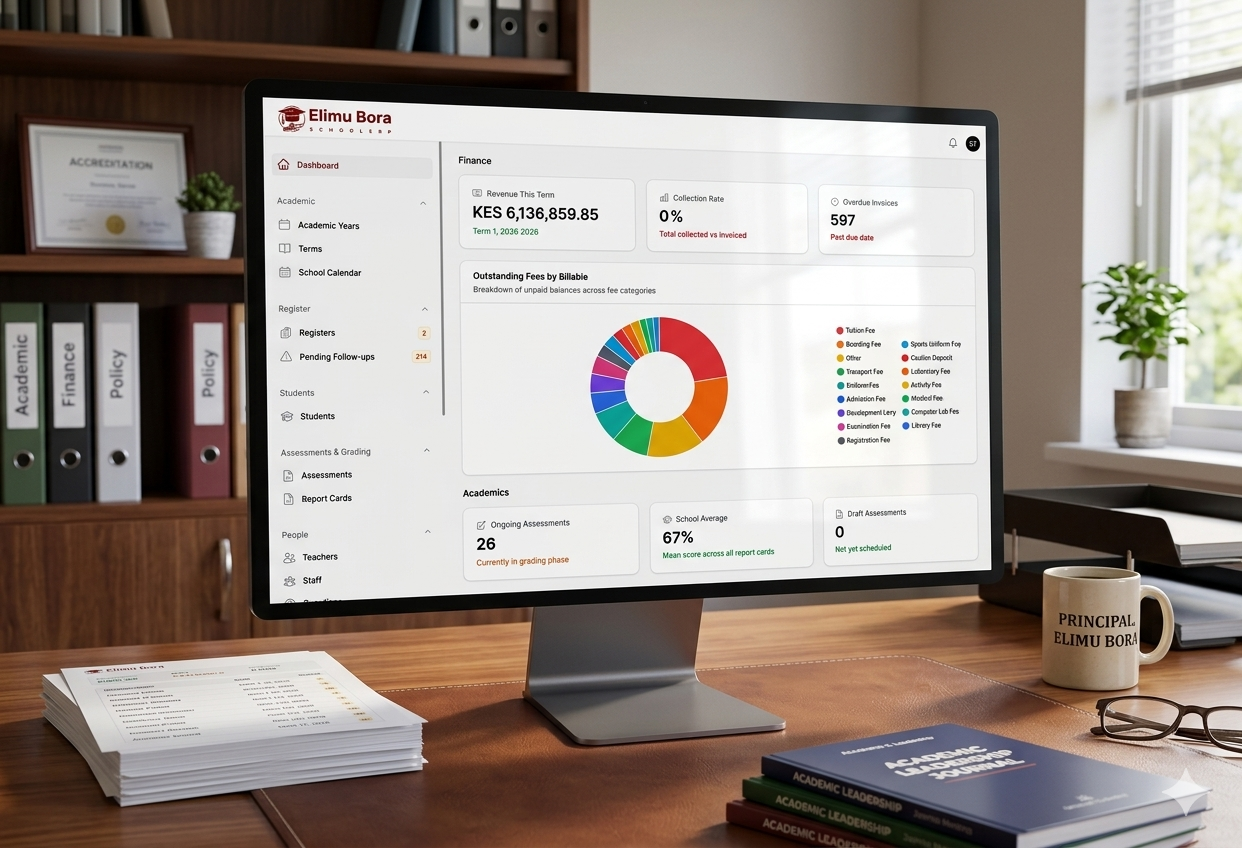
Elimu Bora's Super Admin Dashboard provides a consolidated view of key school metrics, from fee collection to attendance and academic performance.
Something has shifted in the Kenyan education sector this year. Walk into a county education office and the conversation is no longer about whether schools should go digital. It is about how quickly they can get there. Private schools are investing in management platforms to stay competitive. Public schools are being pulled into digital systems by government policy. And the infrastructure that held back adoption for years, unreliable internet, expensive devices, low smartphone penetration, is finally catching up.
This is not a trend that appeared overnight. It is the result of several forces converging at the same time. Here is what is behind it.
The Government Is No Longer Just Talking About It
The biggest signal came on January 9, 2026, when the Kenya Education Management Information System (KEMIS) officially went live. KEMIS replaced the older NEMIS platform, which had been widely criticised for being rigid and difficult to integrate with other government systems. The new system connects all learning institutions, from pre-primary schools to universities, and assigns every learner a unique digital identifier that tracks their entire education journey.
Principal Secretary for Basic Education Prof. Julius Bitok described KEMIS as the largest integrated education data platform in the country. The system is designed to support accurate learner data, smoother transitions under the Competency-Based Curriculum, and better resource allocation across the sector.
What this means for individual schools is straightforward: the government now expects digital record-keeping as a baseline. Schools that are still running on paper registers and manually compiled enrolment numbers will increasingly find themselves out of step with the systems they are required to feed data into.
Alongside KEMIS, the EU-funded Last Mile Connectivity of Schools (LCMS) project has been connecting public primary schools to reliable internet. By December 2025, 363 schools across 14 counties had been connected, reaching over 277,000 learners. An additional 637 schools are planned for connection in 2026. The project, backed by a KES 1.48 billion EU contribution and implemented in partnership with UNICEF and the ICT Authority, is specifically aligned with the Competency-Based Education curriculum.
LCMS School Connectivity — Progress to Date
363
Schools connected
14
Counties reached
277,000+
Learners reached
KES 1.48B
EU contribution
Source: LCMS / EU, December 2025
And in May 2025, the National Digital Literacy Skills Curriculum was launched at the Connected Africa Summit, setting a target to digitally empower 20 million citizens by 2032. Schools were identified as the critical adoption centres for this initiative.
The direction from government is clear. Digital infrastructure in education is now a policy priority, not a pilot programme.
Smartphones Are Everywhere
One of the biggest barriers to school digitisation in Kenya used to be device access. If parents could not receive a notification or check a portal on their phone, there was little point in building one. That barrier has largely fallen away.
By December 2025, smartphone penetration in Kenya had reached 92.9% of all mobile devices, according to the Communications Authority of Kenya. The country had over 48.7 million smartphones in active use, up dramatically from previous years. Entry-level Android devices from manufacturers like Tecno, Itel, and Infinix are now available for under KES 5,000, making smartphone ownership accessible to a much wider population.
Mobile broadband subscriptions reached 61.9 million users, with 4G subscriptions alone growing to 44.2 million. Even 5G, while still early, recorded 1.7 million subscriptions. The total number of active SIM subscriptions hit 78.4 million, pushing mobile penetration to 149.5% of the population.
Kenya Mobile Connectivity — December 2025
92.9%
Smartphone penetration
48.7M
Smartphones in use
44.2M
4G subscriptions
78.4M
Active SIM subscriptions
Source: Communications Authority of Kenya, 2025
For schools, this changes the equation completely. A parent portal, an M-Pesa payment prompt, an absence notification sent to a guardian’s phone: these are no longer features that only work for a small segment of tech-savvy parents. They work for almost everyone.
The CBC Transition Demands It
The ongoing transition from the 8-4-4 curriculum to the Competency-Based Curriculum has created operational complexity that manual systems struggle to handle. CBC introduced new grading formats, learning areas instead of traditional subjects, and competency-based report cards that look nothing like the old percentage-and-rank format.
Schools running both systems simultaneously, which many still are, face a particular challenge. They need to maintain two sets of grading scales, two report card formats, and two assessment workflows, often within the same institution. Doing this on paper or in Excel is not just inefficient; it is a source of constant errors.
Digital school management platforms that support both curricula natively have become a practical necessity rather than a nice-to-have. The demand is coming from teachers who are tired of manual workarounds and from principals who need to produce accurate, curriculum-compliant report cards at the end of every term.
Schools running both CBC and 8-4-4 simultaneously face growing administrative complexity that paper systems were never designed to handle.
Parents Expect Transparency
There was a time when a parent’s only touchpoint with their child’s school was the report card at the end of term and the occasional parents’ meeting. That era is ending.
Urban and peri-urban parents in particular now expect to know what is happening at school in real time. Is my child attending? Has the fee been received? How did they perform in the mid-term assessment? These are questions that used to require a phone call to the school office or a visit. Today, parents expect to log in and see the answers for themselves.
This expectation has been shaped by how every other service in Kenya works. M-Pesa sends instant confirmations. Banks send transaction alerts. E-Citizen provides real-time service tracking. Schools that cannot offer a similar level of visibility are starting to look behind the times, especially private schools competing for enrolment.
For public schools, the pressure is different but equally real. When fee payments are recorded digitally and parents can see a clear breakdown of what has been paid and what is outstanding, disputes drop. When attendance is tracked and parents are notified about absences, accountability improves. These are outcomes that benefit every school, regardless of whether they are chasing competitive advantage or simply trying to run things more smoothly.
The Cost of Not Going Digital
The conversation around school digitisation often focuses on the cost of adopting a new system. But schools are starting to count the cost of not adopting one.
A bursar who spends the first two weeks of every term manually reconciling M-Pesa payments against a cashbook is losing time that could be spent on financial planning. A teacher who fills out paper registers every morning and then has to transcribe the data for end-of-term reports is doubling their workload. A principal who cannot access a consolidated view of fee collection, attendance, or academic performance without requesting reports from three different staff members is making decisions with incomplete information.
These inefficiencies are not just inconvenient. They cost money, they cost time, and in some cases they cost trust. When a parent is told their payment was not received and there is no clear record to check against, the relationship between school and family takes a hit.
Schools that have adopted digital management platforms consistently report the same outcomes: less time on administrative tasks, fewer data errors, faster fee reconciliation, and improved communication with parents. These are not abstract benefits. They translate directly into smoother operations and stronger relationships with the families the school serves.
Both Public and Private Schools Stand to Gain
There is a misconception that school management software is only relevant to private schools with the budget to pay for it. The reality is that public schools face many of the same operational challenges, often at a larger scale and with fewer administrative staff to handle them.
Public schools deal with government capitation tracking, large student populations, complex reporting requirements for the Ministry of Education, and the added pressure of KEMIS compliance. A digital system that handles student records, attendance, and academic data in a structured way makes it far easier to meet these requirements accurately and on time.
Private schools, on the other hand, are driven by competitive positioning. Parents choosing between two schools will increasingly favour the one that offers a guardian portal, digital report cards, and transparent fee tracking. In a market where schools are competing for enrolment, the quality of the administrative experience matters almost as much as the quality of teaching.
The tools available today are built for both contexts. Platforms like Elimu Bora School Management System are designed specifically for the Kenyan school system, supporting both CBC and 8-4-4, integrating with M-Pesa for fee collection, and providing role-based access for principals, teachers, and parents. Whether a school has 150 students or 1,500, the operational benefits are the same.
The Window Is Now
Every indicator points in the same direction. Government policy is pushing schools toward digital record-keeping. The infrastructure to support it, internet connectivity, smartphones, and mobile money, is more accessible than it has ever been. The CBC transition has made manual systems harder to sustain. And parent expectations continue to rise.
Schools that move now will spend the next few terms getting their data in order, training their staff, and building the digital habits that make everything easier over time. Schools that wait will eventually be forced to make the same move, but under more pressure and with less time to get it right.
The question is no longer whether your school should go digital. It is whether you want to do it on your own terms or someone else’s.
Did You Know?
Only an estimated 30% of Kenya’s 23,400 public primary schools were online by early 2026, according to UNICEF. The EU-funded LCMS project plans to connect an additional 637 schools this year, but the gap between connected and unconnected schools remains significant, especially in underserved counties.